
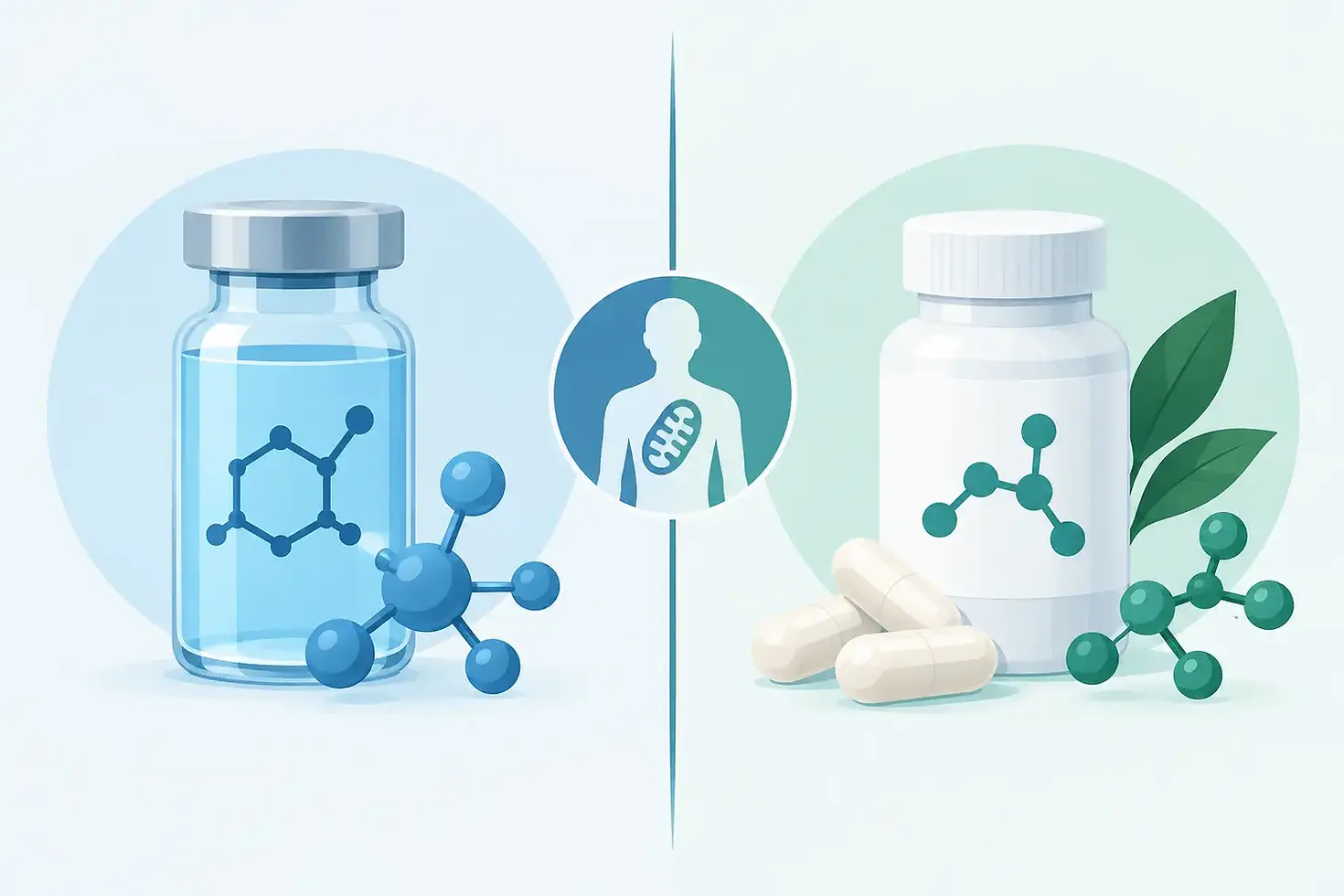
NAD+ Formulations Versus Precursors: Key Differences
A label that says “NAD+ support” does not identify a single experimental variable. It may refer to intact NAD+, a precursor such as nicotinamide mononucleotide (NMN) or nicotinamide riboside (NR), a blend, or an excipient system designed around a particular route of administration. For laboratories comparing NAD+ formulations versus precursors, that distinction should be established before a protocol is written, not after results begin to diverge.
NAD+ is central to redox biology, cellular energy metabolism, and the activity of enzymes including sirtuins, PARPs, and CD38. That broad relevance can make the category appear straightforward. It is not. The material selected, its handling requirements, the biological model, and the analytical endpoint each influence what the study can reasonably show.
Start With the Biological Question
The first decision is whether the experiment is intended to evaluate the behavior of NAD+ itself or the cellular consequences of supplying a substrate that may contribute to NAD+ synthesis. These are related questions, but they are not interchangeable.
Intact NAD+ is the oxidized form of nicotinamide adenine dinucleotide. In a controlled assay, it can be used to investigate direct cofactor availability, enzyme kinetics, extracellular signaling questions, or stability under specific conditions. Its behavior depends heavily on the matrix, concentration, temperature, pH, light exposure, and the biological system in which it is introduced.
Precursors are upstream compounds that participate in NAD+ biosynthetic pathways. NMN and NR are among the most commonly discussed examples, while nicotinamide and nicotinic acid have distinct pathway relationships and experimental considerations. A precursor study asks a different question: whether the model can take up, convert, retain, and use that substrate under the conditions tested.
That conversion step is not a minor detail. It introduces variables involving transporter activity, enzyme expression, competing metabolic demands, cell type, tissue state, and time. A result observed with a precursor cannot automatically be attributed to direct NAD+ exposure, and a result from intact NAD+ does not establish that a precursor will reproduce it.
NAD+ Formulations Versus Precursors: The Core Trade-Off
The practical difference is control versus biological dependency. Working with intact NAD+ may provide a more direct way to interrogate a cofactor-related mechanism in certain systems. Working with a precursor may better model a pathway-based intervention, but the result necessarily depends on the model’s capacity to process that material.
Neither approach is inherently superior. The correct choice follows the hypothesis.
If the objective is to characterize a purified enzyme system, a cell-free reaction, or direct effects within a defined experimental environment, intact NAD+ may be the more relevant input. If the objective is to examine biosynthesis, intracellular pool changes, or pathway response in viable cells, a precursor can be appropriate, provided that conversion is measured rather than assumed.
Researchers should also avoid treating extracellular concentration as a proxy for intracellular availability. NAD+ is a charged dinucleotide, and its movement, degradation, and downstream handling can differ substantially across models. Precursors introduce their own transport and conversion questions. For either category, an exposure concentration alone is not proof of intracellular delivery or functional engagement.
Formulation Is More Than the Active Material
“Formulation” is often used loosely, but it should be read as part of the method. The active compound matters, yet so do the components that influence solubility, pH, osmolality, storage behavior, reconstitution, and compatibility with the intended research system.
A well-designed study documents the full composition of the test article. That includes the identity and concentration of the active material, diluent or vehicle, lot information, storage condition, reconstitution procedure, and time between preparation and use. These controls are especially relevant when comparing different NAD+ preparations or contrasting an NAD+ preparation with a precursor product.
Stability deserves particular attention. Dinucleotide compounds can be sensitive to environmental conditions, and degradation may alter the actual material presented to the assay. A protocol that relies on repeated freeze-thaw cycles, prolonged room-temperature exposure, or poorly defined reconstitution can create variation that appears biological but is actually pre-analytical.
For time-sensitive work, confirm the compound’s identity and concentration at appropriate points in the workflow. If a study spans multiple lots or multiple preparation dates, incorporate lot-to-lot and day-to-day controls. No compromises. No shortcuts.
Design the Comparison Around Measurable Endpoints
A meaningful comparison should not stop at a broad outcome such as viability, morphology, or a single marker. Those observations may be useful, but they do not explain whether the material altered NAD+ metabolism, produced a nonspecific stress response, or interacted with the assay itself.
For precursor experiments, direct measurement of intracellular NAD+, NADH, and where relevant related metabolites provides stronger context. Time-course sampling can help distinguish an early transient change from a sustained shift in cellular pools. Including vehicle controls and appropriately matched controls for osmolarity or pH can prevent formulation differences from being mistaken for active-material effects.
For intact NAD+ studies, assess whether the experimental system can distinguish extracellular compound behavior from intracellular changes. Depending on the model, this may require compartment-aware sampling, enzyme activity assays, or targeted metabolite analysis. The methodology should reflect the question rather than forcing the question to fit a convenient assay.
Replicates should also match the level of inference. Technical replicates help characterize assay precision. Biological replicates are necessary when the claim concerns reproducibility across independent samples, passages, preparations, or experimental days. A clean result from one plate does not establish a reliable mechanism.
Sourcing and Documentation Affect Interpretability
The quality of a research material is part of the experimental design. An uncertain identity, incomplete purity data, inconsistent fill weight, or undocumented handling history can compromise even an otherwise rigorous protocol.
For NAD+ formulations and precursors, evaluate supplier documentation with the same discipline applied to analytical reagents. At minimum, researchers should be able to verify the material identity, stated purity or assay, lot designation, storage guidance, and relevant testing records. Certificate data should be reviewed in the context of the method used, not treated as a generic quality signal.
Manufacturing controls also matter. Materials produced under defined quality systems and supported by lot-level testing reduce avoidable procurement risk. They do not replace independent verification when the study is high stakes, but they establish a more reliable starting point. MARx Therapeutics approaches research supply with that standard in mind: precision, documented quality, and clear sourcing expectations.
Avoid Overreaching From Mechanism to Outcome
NAD+ research attracts broad interest because the molecule sits at the intersection of multiple biological systems. That interest can encourage conclusions that extend beyond the data. A measured increase in a cellular NAD+ pool does not, by itself, demonstrate a specific downstream functional outcome. Likewise, a change in one model may not translate across cell types, tissues, species, or routes of exposure.
The cleanest interpretation states what the experiment tested, what was measured, and what remains unresolved. If a precursor increased an intracellular metabolite under defined conditions, report that result. Do not recast it as evidence that intact NAD+ would behave identically. If an NAD+ formulation altered an in vitro endpoint, do not assume the effect reflects precursor conversion or a broader physiological response.
This restraint is not a limitation. It is what makes the work useful to the next laboratory.
The Better Choice Is the One That Reduces Ambiguity
Choose intact NAD+ when the hypothesis requires direct cofactor input or defined extracellular exposure. Choose a precursor when the hypothesis concerns biosynthetic capacity, metabolic conversion, or pathway-dependent changes in a viable model. In either case, specify the formulation, protect sample integrity, measure the variables that connect exposure to mechanism, and source materials with documentation that can withstand review.
The most valuable NAD+ study is rarely the one with the broadest claim. It is the one in which another researcher can identify the exact material, repeat the conditions, and understand precisely what the data support.



Comments